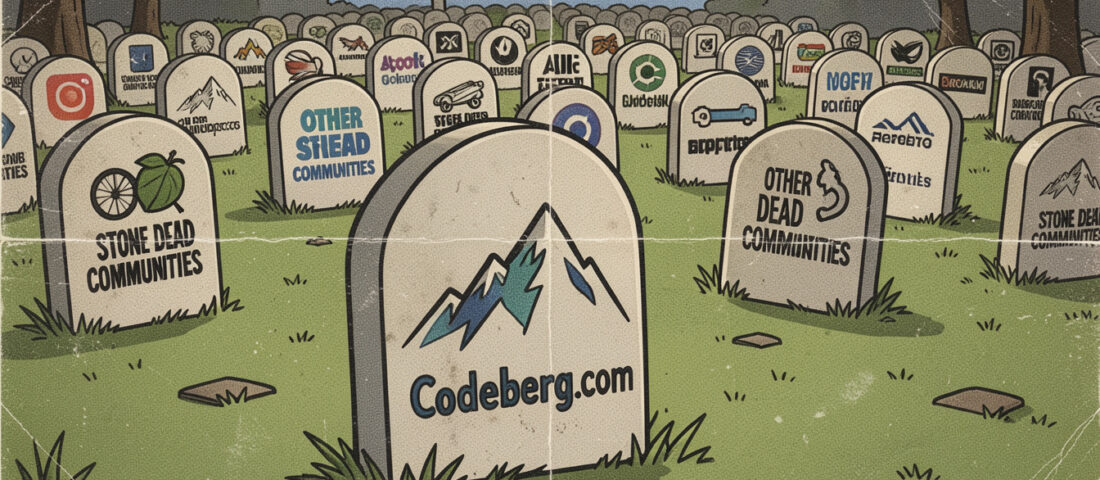
..or at least the painful spectacle of watching someone trying to put the genie back in the bottle…
Codebergs members recently voted for a ban on code “mostly” written by AI.
7. You must not share projects that mostly consist of code written by “generative AI”-tools (including services such as *Claude*, *OpenAI Codex*). Such projects having an unclear copyright status (see requirements § 2 (1) 1 and § 2 (1) 3) and furthermore have little safeguards to ensure that they do not include harmful code (c.f. § 2 (1) 5).
This is of course the sort of vague rule wording that is symptomatic for, just a feeling that you don’t like something and don’t want it. Vague formulating that inevitably will lead to internal conflicts, fingerpointing at those that might not be “real” enough and eventually vacating of Codeberg. What is “mostly” anyway? After carefully having designed an idea and a purpose that comes out of a need for a solution to a real technical problem that I as a human have, I will happily leeave the grunt work of actually writing the code up to AI. Thus my amazing human brain can focus on development and refining instead of trying to formulate regular expressions and getting them wrong fifteen times in a row or just writing tedious bits of code. I happily save time on structuring text and translating documentation to sometimes multiple languages for accesibility, and and most of all I happily leave building tests over to AI. This doesn’t mean that I am not in the loop, neither does it mean I didn’t create the product, I certainly didn’t write “most” of the code, but I reviewed it, I tested it and I made sure it does what I want it to do. I am certainly the director of the movie.
Who makes the world a better place?
Codeberg writes in their blog:
sharing the result of an prompt and calling it “libre software” does not make the world a better place.
Codeberg does actually makes the world a better place. Codeberg is a FLOSS (Free/Libre Open Source Software) community, it’s small and run by volunteers. Open source is amazing, sharing knowledge is beautiful and building and improving on the ideas of others is after all the very essence of human creativity. Regardless of the tools involved. Being a small initiave with limited resources the rather sudden influx of mostly “slop” is of course a real problem. It might not be the easiest task to sort it out in a fair way. But rather than with a vague wording of the rules banning “mostly” AI written code you should maybe focus on the code itself.
Just sharing some code that you wrote all by yourself does not make the world a better place either, whatever you call it. It all comes down to the code itself. Does it work? Does it solve a problem and does it fulfill an actual need. Let’s face it, there is a lot of crappy code out there, some of it is written by AI for sure, but most of it is written by humans. I understand the reservations a “real” coder might have. This is one of those disruptive technologies that takes away a bit of what used to make you unique. It democratizes access to being able to create computer programs, pretty much as modern smartphones once democratized photograpy or videography. Videographers weren’t to thrilled about that either. And sure, a lot of shite has been produced since everyone and their grandma got a camera in their pocket, but also some really, really good stuff by people that might never have had the opportunity otherwise.
This is a revolution and as with all revolutions some people are going to be dissapointed as they loose some of their former glory and power, as per usual they might sit on the sidelines and cry about it for a while, “it not genuine”,”it doesn’t have the feel and patina of grainyness and scratches” or whatever. And some of them might even try to throw their wooden shoes into the machinery and actually try to stop the development.
I understand it though. The feeling is real, AI is scary and problematic in some ways. A lot of people will likely try to use it for bad things as per usual, but should that stop great “coders” to use it for good things though? Being a great open source community that actually do make the world a better place, I think Codeberg also has a responsibilty to include and embrace new creators. Especially those with that genuine interest and maybe even pathos for the beauty of sharing, even if they aren’t exactly “real” coders.
To finish off by answering my own question. No. I don’t think this means the death of Codeberg. But it probably means that they have painted themselves into an ideological corner. And also it made you read this article. 🙂